

 Language


News
The design method of bare board power module is introduced, come and collect!
Release time:
2022-11-04 09:21
Source:
The electromagnetic interference level of bare board power module is the most difficult part in the design. The most designers can do is to fully consider the design, especially in the layout. Because DC-DC converters are very commonly used, hardware engineers will be more or less exposed to related work. The following is an introduction to the design method of bare board power module.
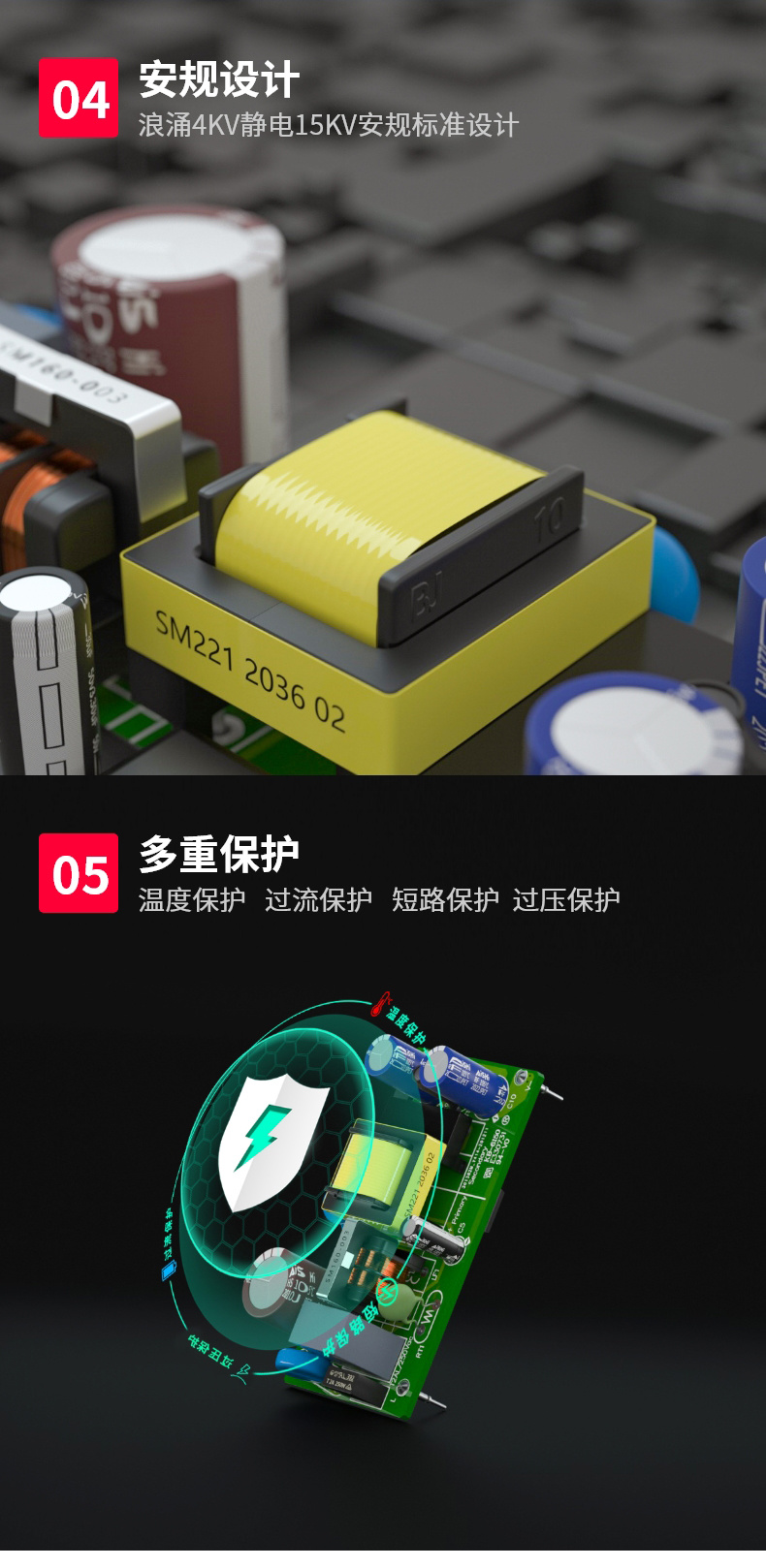
In the design of bare board power modules, even ordinary DC-DC switching converters will have a series of problems, especially in the design of high-power power supplies. In addition to functional considerations, engineers must ensure the robustness of the design to meet the requirements of cost targets, thermal performance and space constraints, while ensuring the design schedule. In addition, considering the product specifications and system performance, the electromagnetic interference (EMI) generated by the power supply is sufficiently low. However, the electromagnetic interference level of the power supply is the most difficult item in the design to predict accurately. Some people even think that this is impossible. The most designers can do is to fully consider the design, especially the layout.
Although the principles discussed in this article are applicable to a wide range of power supply designs, we will only focus on DC-DC converters here, because its applications are quite extensive, and almost every hardware engineer will be exposed to related work, and it may be necessary to design a power converter. In practical applications, it is likely to encounter odd harmonic emission and even harmonic emission at the same time. If only odd harmonics are generated, the duty cycle of the waveform is accurate to 50%. However, bare board power modules rarely have such duty cycle accuracy.
The electromagnetic interference amplitude of series harmonics is affected by the on-off of Q1 and Q2. When measuring the rise time tr and fall time tf of the drain-source voltage VDS, or the rise rate di/dt of the current flowing through Q1 and Q2, This can be clearly seen, which also means that we can reduce the level of electromagnetic interference by reducing the switching speed of Q1 or Q2. In fact, extending the switching time does have a great impact on harmonics with frequencies higher than f = 1/tr, but at this time a compromise is made between increasing heat dissipation and reducing loss. Nevertheless, the bare board power module controls these parameters. It is still a good method, which helps to strike a balance between electromagnetic interference and thermal performance, which can be achieved by adding a small resistance (usually less than 5), this resistor may be connected in series with the gates of Q1 and Q2 to control tr and tf. You can also connect the "turn-off diode" in series with the gate resistor. With the individual control conversion time tr or tf, in fact, this is an iterative process. Even the most experienced power supply designers use this method. Our ultimate goal is to reduce electromagnetic interference to an acceptable level by slowing down the switching speed of the transistor, while ensuring that its temperature is low enough to ensure its stability. The above is an introduction to the design method of bare board power module, and I hope it will be helpful to you.
Previous Page
Related News
2019-08-06
Product selection and application considerations
The design power of each product of our company will have a certain amount of redundant power, which can run for a long time under full load or even over the rated load. However, for the sake of high reliability and prolonging the service life of the power supply, please do not let the load reach the rated value. It is generally recommended to use 60%-80% of the rated load, and the ambient temperature is recommended to be about 30 ℃, which can be fully loaded at an ambient temperature of 55 ℃, but this will undoubtedly greatly reduce the reliability and service life of the product. In actual use, please pay attention to the two factors of controlling load and temperature. If the ambient temperature is relatively high, it is necessary to reduce the load as much as possible (that is, to increase the load margin and select products with greater output power). On the contrary, if a large load current is required, then try to do a good job of ventilation and heat dissipation, such as placing the power supply module in an open space and increasing cooling fans. The specific value is not absolutely fixed. Generally, it is recommended that the load should not exceed 20% of the rated load when the ambient temperature is 55 ℃, which can keep the product very high reliability. Tip: Please use temperature measuring equipment to evaluate the temperature, and do not rely on skin feeling. Short time and a small proportion of full load, high temperature operation, the reliability and life has little effect. For example: each full load lasts less than 1 minute or half a minute, and the interval is more than 10 minutes, while the load during the interval is less than 15% of the rated load, then even if the operation at 55 ℃ is also possible. Safe Use Warning: Since the bare board series does not have a shell, the input is 220V AC at the same time. The input pins and corresponding terminals of the module are directly connected to 220V. Please pay great attention to prevent short circuit between electric shock and metal objects and ensure that the power supply is disconnected before any touch. Load Requirements for 2. Use of Multiple Output Power Supplies Generally, the voltage accuracy of the output of the multi-output power supply is: the nominal value of the main output is plus or minus 1%, and the nominal value of the secondary output is plus or minus 5%-10%. The first output of the multi-output power supply is the main circuit, and the other output is the secondary circuit. The voltage accuracy and carrying capacity of the main circuit are higher than those of the secondary circuit. Therefore, the main circuit with large current and high voltage accuracy requirements should be generally selected, it is appropriate that the ratio of each current is 50-100%, and the secondary circuit must not be loaded separately under the condition of no load on the main circuit, otherwise the secondary circuit voltage is too low to be used normally. In addition, if the main circuit load is full load and the secondary circuit load is light load, the secondary circuit voltage may increase, otherwise the secondary circuit voltage will decrease, and the reliability and service life will have little effect. For example, if each full load lasts less than 1 minute or half a minute, and the interval is more than 10 minutes, while the load during the interval is less than 15% of the rated load, then even operation at 55°C is possible.
2018-08-29
Application field of switching power supply module
Switching power supply module is applied in several major aspects 1. Electric power, mainly including integrator and electric meter and intelligent electric meter 2. Industrial control, industrial control field 3. Medical treatment, medical equipment, mainly including tire protection instrument, monitor and so on 4. Military industry, military industry is a very widely used aspect. in military equipment. Switching power supply module applications in several major areas.
2018-08-29
Precautions for the use of switching power supply modules
The high-frequency transformer of switching power supply is generally shielded for the first time, which is not described above. Switching power supply is a high-frequency product, PCB component layout for EMI, please pay close attention to this point. If the switching power supply has a mechanical shell, the structure of the shell has a great influence on the radiation, please pay close attention to this point. The parameters of different manufacturers of the main switch tube and the main diode have certain differences, which have certain influence on EMC. Please pay close attention to this point.
2018-08-29
Can switching power supply and module power supply be universal?
A module power supply is a power supply that can be mounted directly on a printed circuit board and is characterized by providing power to application-specific integrated circuits (ASICs), digital signal processors (DSPs), microprocessors, memory, field programmable gate arrays (FPGAs), and other digital or analog loads. In general, such modules are called point-of-load (POL) power supply systems or point-of-use power supply systems (PUPS).
2018-08-29
The difference between switching power supply and module power supply
(1) The difference in use: module power supply, output voltage, remote control switch circuit, input protection circuit. Switching power supply, control the switch tube on and off time ratio, maintain a stable output voltage of a power supply. (2) The difference in composition: Switching power supply: Generally composed of pulse width modulation (PWM) control IC and MOSFET. Module power supply: it is composed of power supply module with a small amount of discrete components.
2018-10-19
Loss of switching power module
The loss of high-power module switching power supply mainly includes high-frequency switching loss, high-frequency transformer loss, rectifier loss and line conduction loss. In the application of low voltage and high current output, the rectifier loss and line conduction loss occupy a larger proportion, the lower the output voltage, the greater the output current, the rectifier loss and line conduction loss accounted for the proportion of the total loss of the module switching power supply.
Advisory Hotline
Contact: Liu Gong
Telephone:86-20-37720376
Mailbox:sales@sanmim.com
Address: Building D, Micro Think Tank Industrial Park, No.8 Xianke 1st Road, Xiutang Village, Huadong Town, Huadu District, Guangzhou City, Guangdong Province

WeChat Public Number

Mobile phone mall
©2023 Guangzhou Sanmin Electronic Technology Co., Ltd. All rights reserved